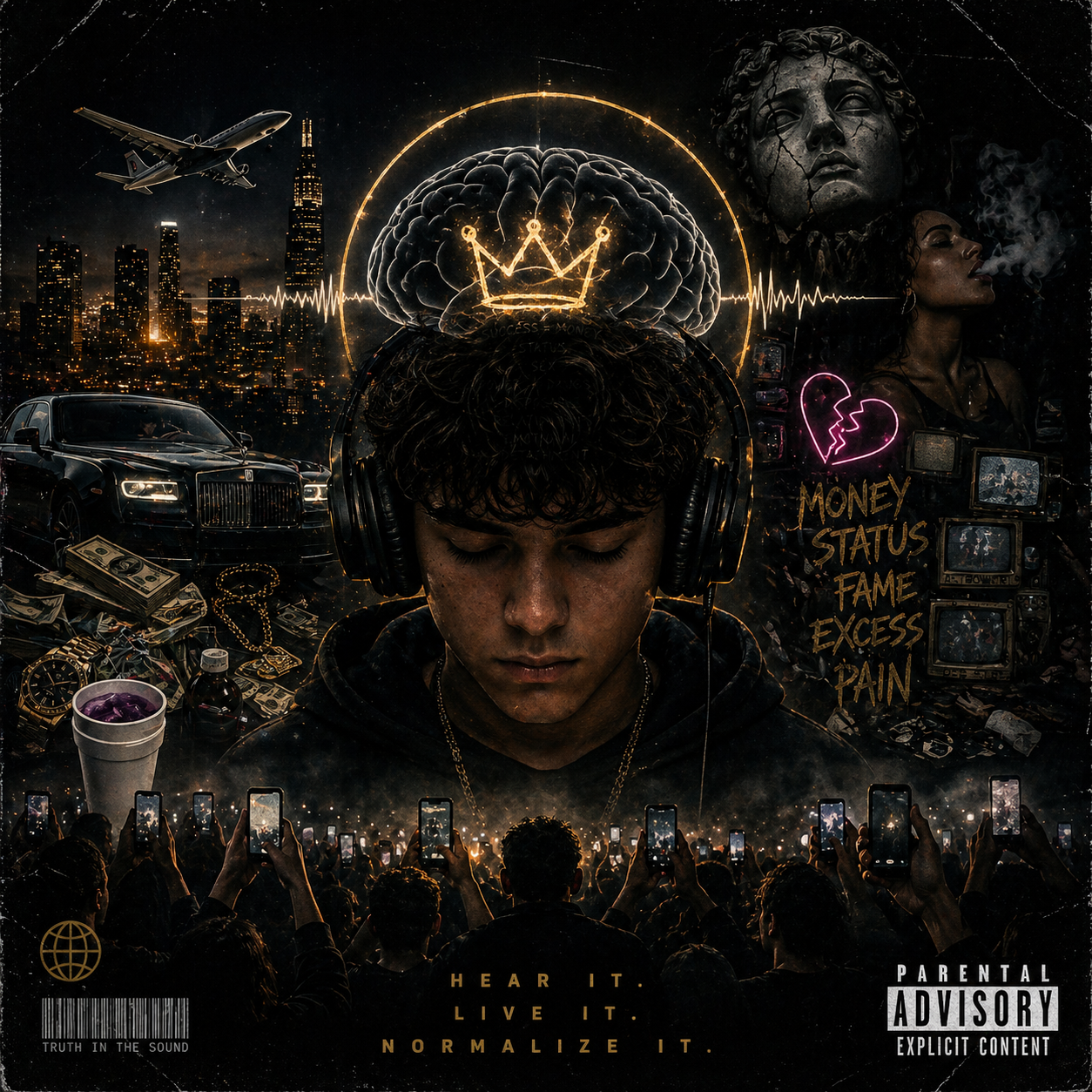
This article looks at how mainstream, high-exposure music can shape culture not through one song or one artist, but through repetition. It focuses on recurring themes like money, status, sex, substance use, aggression, and emotional detachment, then connects those patterns to research on media exposure, social norms, and normalization. The argument is not that music controls people. It is that what gets repeated often enough starts to feel normal.
At first, it just sounds like music.
Then you start noticing the patterns.
And once you notice it, you can’t unhear it.
Walk into a gym, open a social app, sit in a car, scroll for five minutes. You’ll hear it.
Different songs. Different artists. Same message.
You don’t have to go looking for it. It’s already there, playing in the background of everything. Not all music sounds like this. A lot of it doesn’t. But the music that gets the most reach, the most replay, the most visibility often does. And over time, what you hear the most starts to feel like what’s normal.
This isn’t about one artist or one song. It’s about what keeps showing up in mainstream, high-exposure music. Pay attention long enough and you start to hear it clearly. Money is everything. Status is everything. Sex is everywhere. Relationships feel disposable. Emotions are either turned all the way up or completely shut off. And it’s rarely just one of these at a time. They show up together, over and over, in the songs people hear the most.
This didn’t happen overnight. Music has always pushed boundaries. What’s different now is how consistent it is and how often people hear it.
Look at some of the biggest songs from the past decade. Bad and Boujee is built on wealth and status. HUMBLE. plays with power and ego, even while pushing against it. XO Tour Llif3 mixes emotional numbness with substance use. Mask Off leans into drugs as identity. Rockstar ties fame, excess, and antisocial behavior into a single persona. These weren’t niche tracks. They were everywhere.
The research lines up with what you’re hearing. Studies have tracked increases in drug references over time (Herd, 2008), along with ongoing patterns of sexual and objectifying content in mainstream lyrics (Adams and Fuller, 2006; Weitzer and Kubrin, 2009; Wright et al., 2017). Other work shows that popular songs often include antisocial or provocative themes (Primack et al., 2017). That’s the academic version of what most people already sense.
The part people underestimate is this. It’s not the message. It’s the repetition.
Take a few more songs that dominated streams. WAP puts explicit sexuality front and center. Sicko Mode mixes wealth, chaos, and dominance. God’s Plan ties identity to success and money. Life Is Good keeps coming back to money and lifestyle. HIGHEST IN THE ROOM blends status, isolation, and substance use. On their own, they’re different. But when you hear them all the time, the differences start to fade.
There’s a difference between hearing something once and hearing it every day, across artists, platforms, and contexts. At some point, your brain stops treating it like background noise and starts treating it like reality. Research has shown that repeated exposure can shape attitudes and expectations, especially for younger listeners (Martino et al., 2006; Primack et al., 2009). Even short bursts of aggressive content can shift how people think and feel in the moment (Anderson et al., 2003). Social norms research shows that what people see and hear repeatedly starts to feel typical (Berkowitz, 2004; Perkins, 2002).
The bigger issue is not just that these themes exist. It’s that they show up together. Look at songs like Industry Baby, where success, attention, and image all blend together. Money in the Grave turns wealth into identity. Drip Too Hard is built on status and image. The Box ties money and power into one narrative. Money connects to status. Status connects to attention. Attention connects to desirability. Desirability connects to identity. It loops.
Here’s a quick snapshot across some of these songs:
| Song | Money/Status | Sexualization | Drugs/Alcohol | Aggression/Violence | Emotional Detachment |
|---|---|---|---|---|---|
| Bad and Boujee | ✓ | ✓ | ✓ | ✓ | ✓ |
| Rockstar | ✓ | ✓ | ✓ | ✓ | ✓ |
| Sicko Mode | ✓ | ✓ | ✓ | ✓ | ✓ |
| WAP | ✓ | ||||
| Life Is Good | ✓ | ✓ | ✓ | ||
| XO Tour Llif3 | ✓ | ✓ | |||
| Mask Off | ✓ | ✓ | |||
| The Box | ✓ | ✓ | |||
| Drip Too Hard | ✓ | ✓ | |||
| Money in the Grave | ✓ | ✓ |
It’s not a perfect breakdown. It doesn’t need to be. The pattern is obvious. Most of these songs carry more than one of the same themes, and those combinations keep repeating.
Now add one more piece that usually gets left out.
The music that dominates isn’t just popular. It’s extremely profitable.
Top artists in this space regularly earn tens of millions of dollars a year. Drake has consistently been among the highest-earning artists, with annual income often reported between $50 million and $80 million depending on touring and releases. Travis Scott’s Astroworld tour grossed over $50 million, and major tours across the industry regularly bring in $100 million to $300 million or more.
Streaming adds another layer. Spotify pays roughly $0.003 to $0.005 per stream. That doesn’t sound like much until you realize that top songs pull in hundreds of millions to billions of streams. A single track can generate millions of dollars and reach massive audiences at the same time.
And that’s just the direct revenue.
Those same songs lead to endorsement deals, festival headlining spots, brand partnerships, and long-term income. The system rewards what performs. And what performs gets repeated.
Music used to be something you chose. Now it’s something you’re surrounded by. You hear it scrolling. You hear it in the car. You hear it in the background of everything. The same hooks. The same ideas. The same tone. No one sits down and decides this is what they want to believe. It just gets familiar.
That’s how environments work.
It doesn’t control people. But it shapes what feels normal. If relationships are always framed as transactional, that starts to feel less strange. If everything is about money and status, that starts to feel like the goal. If substance use is tied to lifestyle, it feels less unusual. If emotional detachment shows up everywhere, it starts to feel like how people operate.
At some point, you have to ask what all of this is teaching. Not in a dramatic way. Just honestly. What does this say about what matters, what success looks like, how people treat each other, what relationships are supposed to be?
Because repetition teaches, whether we acknowledge it or not.
Artists will keep creating. That’s not the issue. The issue is what gets amplified. Culture moves toward what gets attention. And right now, what gets attention is intensity, exaggeration, and extremes.
Look at it clearly.
The songs that dominate make money.
The ones that make money get pushed.
The ones that get pushed get repeated.
And what gets repeated becomes normal.
That’s the loop.
Not random. Not accidental.
So the question isn’t whether music influences people.
It’s whether we’re paying attention to what’s being repeated enough to shape what people think is normal.
References
Adams, T. M., & Fuller, D. B. (2006). The words have changed but the ideology remains the same: Misogynistic lyrics in rap music. Journal of Black Studies.
Anderson, C. A., Carnagey, N. L., & Eubanks, J. (2003). Exposure to violent media: The effects of songs with violent lyrics. Journal of Personality and Social Psychology.
Berkowitz, A. D. (2004). The social norms approach: Theory, research, and annotated bibliography.
Herd, D. (2008). Changes in drug references in rap music, 1979–1997. University of California, Berkeley.
Martino, S. C., Collins, R. L., Elliott, M. N., et al. (2006). Exposure to degrading versus nondegrading music lyrics and sexual behavior among youth. Pediatrics.
Perkins, H. W. (2002). Social norms and the prevention of alcohol misuse.
Primack, B. A., Gold, M. A., Schwarz, E. B., & Dalton, M. A. (2009). Degrading sexual lyrics and adolescent behavior. Pediatrics.
Primack, B. A., et al. (2017). Content analysis of popular music and antisocial themes.
Weitzer, R., & Kubrin, C. E. (2009). Misogyny in rap music: A content analysis. Men and Masculinities.
Wright, P. J., et al. (2017). Thematic analysis of mainstream rap music and sexual content.